


The SLU-stainability problem
- Sanjott Singh
- May 7, 2021
- 3 min read
For a university that touts its environmental friendliness, a sustainability problem arises in Saint Louis University's reliance on one-use containers. Should SLU put their money where their mouth is and invest in reusable containers and utensils for their students?
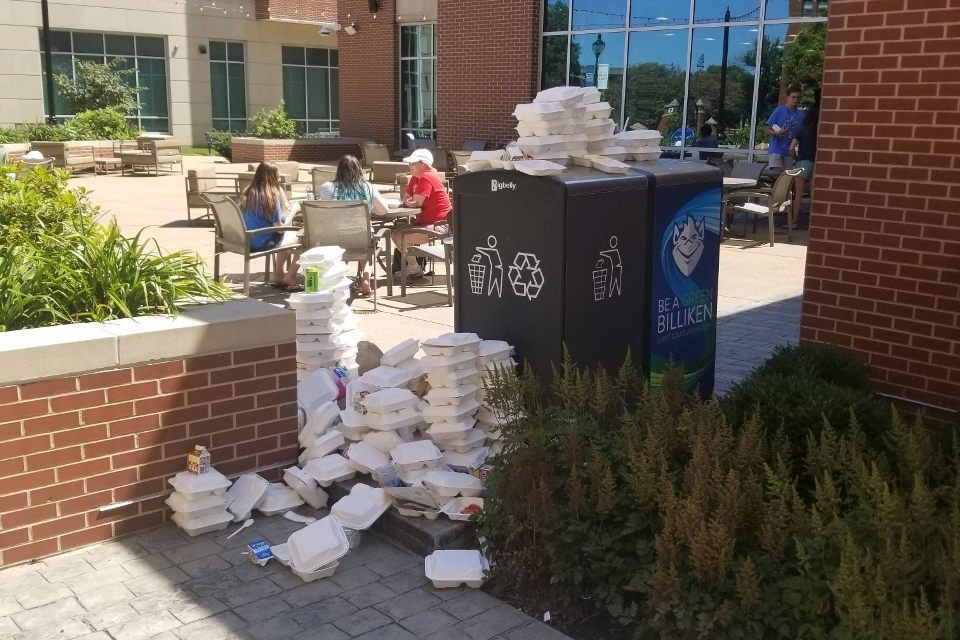
Following the return of in-person courses, Saint Louis University has increasingly relied on one-use to-go containers in its on campus dining locations. In terms of the environmental impact of its dining services, has SLU bit off more than it can chew?
Plastic wrappers floating in the wind. Empty soda cans collecting on curbsides. Overflowing BigBelly recycling units. These are some of the sights complementing Saint Louis University's lush flora and fauna following the return to in-person classes.
Since students have returned to campus, SLU dining locations, especially the flagship Grand Dining Hall, have begun to use one-use containers in place of their reusable dishes and silverware. These one-use containers are made of recycled paper, some with plastic lids. Drinks are no longer self-serve, replaced by individual plastic bottles and metal cans. Utensils are packaged in plastic wrap, containing a plastic fork, knife and spoon, in addition to condiments and napkins.


All north campus locations, including Grand Dining Hall, are managed by Sodexo, a food services and facilities company under a contractual agreement with SLU. Prior to the COVID-19 pandemic, Sodexo championed sustainability in Grand Dining Hall.
One such sustainability method was trayless drying, where reusable dishes and silverware were washed and cycled, minimizing waste and conserving energy and water.
In addition, Sodexo offered a reusable to-go container program, where students could purchase a reusable container for $5, which could then be used in Grand Dining Hall, and exchanged for a clean one when returned.





Both of these programs were halted due to the pandemic, the main concern being surface contamination. In response to CDC guidance, Grand Dining Hall began using individually packaged one-use containers.
"Most food items are now pre-packaged and stations like the salad bar, Grilliken, pizza and dessert are no longer self-service" said Tom Hosemann, DineSLU's Residential Dining Director. Social distancing has "greatly reduced seating capacity in the dining hall, so everyone this year is allowed to take their meals to go. We also have the option of seating outside on our patio."
This continues to be the practice, although the CDC has altered their guidance, stating that the risk of surface contamination of COVID-19 is low. This gives the green light for reusable containers and utensils to be used once again.


SLU's reliance on one-use containers and utensils poses an environmental problem, as litter is often found strewn across campus, and much of the paper/plastic containers do not find their way to recycling bins.
If the recyclables do end up in SLU's recycling bins, the since stream recycling method used by the City of St. Louis advises that all items are kept loose, clean and dry. This is a problem for dining, as food and liquids are often left in the containers, making them unsalvageable, as well as contaminating everything else in the blue bins. What might of gone into recycling, now goes into the trash.
A possible solution to the "SLU-stainablility" problem is to provide all students with reusable containers and utensils. "We're wanting to work with DineSLU, SGA and the university to have reusable containers as an option in addition to composting expansion and improvement" said Madeleine Thompson, president of Green Billikens, SLU's student-led sustainability group. "I think it's attainable because they already give freshmen the reusable water bottles and they already have places you can purchase reusable utensils. So, I don't it's too much of a stretch to ask SLU to provide the reusable containers."
Currently, Saint Louis University's dining facilities continue to utilize one-use containers. According to Thompson, ways that students can help the environment right now include talking to people about environmental issues, reducing your resource use, starting your own composting, learning what you can recycle and educating yourself."Educating yourself and trying to stay optimistic is the key into doing any environmental action" said Thompson.


Comments